Sunday, 28 February 2010

Thursday, 25 February 2010
SKILLS AUDIT: FILMING AND EDITING PRELIMINARY MATCH CUT EXERCISE

In today’s lesson we were set a task to make a film for our opening match cut exercise. First we filmed it in a classroom and carried on with our storyboard plan. It was difficult, but then we got used to it and finished the exercise. It got easier because we experienced filming and editing before. As a group we then had to use live type and soundtrack pro to create our titles and sounds. Because we had practise before we were able to:
•Delete
•Shorten
•Change shots.
Tuesday, 23 February 2010
PLANNING PRELIMINARY MATCH CUT EXERCISE INCLUDING STORYBOARD
In today’s lesson we were set a match cut task where we were asked to make a succession about a character that enters a room, sits down opposite the other character and they talk about something private. As a group we came up with a storyboard on how the plot would look like. Firstly we started planning the storyboard then for the main task we went through our notes and we decided to come up with 16 shots.
Storyboard:
Sht 1) A long shot of the actor walking down the corridor
Sht 2) A cutaway of the actor holding the door knob
Sht 3) A point of view shot of the classroom as the door is opening
Sht 4) A point of view shot of a actor looking at the other actor
Sht 5) ''
Sht 6) A OSS shot of the actor walking towards the table
Sht 7) A close up of the actors hands pulling the chair
Sht 8) A long shot of the actor sitting down
Sht 9) A long shot and two shot of both actors sitting on the table
Sht 10) Shot reverse shot of the conversation between the two actors
Sht 11) ''
Sht 12) ''
Sht 13) ''
Sht 14) ''
Sht 15) ''
Sht 16) ''
Storyboard:
Sht 1) A long shot of the actor walking down the corridor
Sht 2) A cutaway of the actor holding the door knob
Sht 3) A point of view shot of the classroom as the door is opening
Sht 4) A point of view shot of a actor looking at the other actor
Sht 5) ''
Sht 6) A OSS shot of the actor walking towards the table
Sht 7) A close up of the actors hands pulling the chair
Sht 8) A long shot of the actor sitting down
Sht 9) A long shot and two shot of both actors sitting on the table
Sht 10) Shot reverse shot of the conversation between the two actors
Sht 11) ''
Sht 12) ''
Sht 13) ''
Sht 14) ''
Sht 15) ''
Sht 16) ''
Monday, 22 February 2010
Pitch/Preliminary Match Cut Exercise and Storyboard
Pitch
For out Thriller film, we came up with the name Day 56. This name best reflects our story as the main character will have a diary and will write all of his life in there. Other names were suggested such as Memory lane and Disturbia, but we thought that they were to obvious and did not best represent our film.
Our film is a Psychological Thriller. The main character suffers from amnesia and in order to remember his past, he must write down in his diary everything that has happened. When he writes down an event that has just happened, this will trigger his memery to see many flashbacks of the past. Our film was influenced by mainly "The Butterfly Effect". In this film the main character also suffers from amnesia and goes through a series of flashbacks. "Marathon Man" also influenced our film, in the begining of "Marathon Man" the main character is shown running/jogging down the street. We took some of the aspects of that scene, but made it our own.
For out Thriller film, we came up with the name Day 56. This name best reflects our story as the main character will have a diary and will write all of his life in there. Other names were suggested such as Memory lane and Disturbia, but we thought that they were to obvious and did not best represent our film.
Our film is a Psychological Thriller. The main character suffers from amnesia and in order to remember his past, he must write down in his diary everything that has happened. When he writes down an event that has just happened, this will trigger his memery to see many flashbacks of the past. Our film was influenced by mainly "The Butterfly Effect". In this film the main character also suffers from amnesia and goes through a series of flashbacks. "Marathon Man" also influenced our film, in the begining of "Marathon Man" the main character is shown running/jogging down the street. We took some of the aspects of that scene, but made it our own.
Through the uses of the camera work in "Marathon Man" We will try and use some of the aspects, by showing some running scenes, then cut back to normality with the main character writing in his diary. "The Butterfly Effect is shown as psychological as he is also running frantically. He then goes into a room and writes in his diary leading to a flashback. We will take some of this and try to make it more thilling.
For our sub-genre, we choose to do a Psychological thriller. We chose this because we wanted to be different as everyone else chose to do an action thriller. Psychological thrillers are more challenging. They require the audience to really think, so we got inspired by this. A psychological thriller is a thriller where the actor/actress conflict is mental and emotional rather than physical.
Our location to film consisted of two places. We chose to film in a house when the main character lives. This is his comfort space as he will run to his house and takes a deap breath as he will feel safe. Our other location is Hampstead Heath. In this location, we will be filming the running scenes and some other scencs such as houses and parks.
We will use some props that best shows that we linked our title to our film. Our most important prop is the diary that the main character will be using to write down eveything that has happened to him. Our main character will be dressed in casual clothes as we do not want to it to be obvious that he is a mental patient who suffers from amnesia. We will use other smaller pros like perhaps a music box or swings in a park. We will aslo use a house.
Our first shot will be the production company in white font on a black backgroud followed by the distribution company. The nest shot will be a POV shot of the main character running down the corridor to a room. As he enters the room the camera will be panning to the right when he sits at the corner. He will then begin to write in his diary and the camer will be at eye level. A close up will appear to the diary and differnt various shots of him will also appear. The camera will then zoom into his face and after this the flashbacks will appear. Different shots will appear in the flachbacks such as his jewelry box, different shots of houses and him running in the park. Our titles will begin when we see the main character, the music however will start as soo as the flash backs come up. Our main title "Day 56" will come up at the end.
We chose to film on days where we were all present:
Monday: 9am - 2pm - Room scenes
Wednesday: 3pm - to any time - running scenes in Hampsted Heath
Thursday: 1:15pm - 2:55pm
Friday: 4:30 onwards (final touches/ extra scenes)
Sundays: (Only if needed)
In our media lesson, we sat through a presentation about the health and safety of the camera and how to use them. We were informed that one person from our group must give in their phone number incase the technician wanted to contact us. We were also informed to give the location where we were planning on filming and how long we would be there.
In another media lesson, we were introduced to 3 new progams. Final cut pro, Livetype and Soundtrack pro. We learned how to edit some clips, create titles and add effects, and how to create music from scratch.
We chose "Working Title" to produce our thriller. We chose this comapany because it is a British film comapany that we could possibly afford. Our film is a low budget independant film and "Working Title" manly produces this. "Working Title" has a great reputation and we may gain audiences from America as they are loinked with Paramount Pictures.
Our target audience are aged 16 - 24. We chose this technacally savvy audience because our film consits of many fast paced flashbacks that are thrilling. Our main character is young and will appear to a young audience as they may relate to him.
Preliminary Match Cut Exercise and Storyboard
In Media, we were told to make a sequence which included a range of match cuts and some dialogue between two characters. Our storyboard consists of 16 shots, these are the following:
Shot 1: A long shot of the character walking on the hallway
Shot 2: A cut away shot of the characters hands on the door
Shot 3: A pov shot of the classroom as the door is opening
Shot 4: A pov shot of a character looking at the other character
Shot 5: A pov shot of the other character looking at the character
Shot 6: A ots shot of the character walking towards the table
Shot 7: A close up of the characters hands pulling the chair
Shot 8: A long shot of the character sitting down
Shot 9: A long shot/two shot of both characters sitting at the table
Shot 10: Shot reverse shot in dialogue
Shot 11: Shot reverse shot in dialogue
Shot 12: Shot reverse shot in dialogue
Shot 13: Shot reverse shot in dialogue
Shot 14: Shot reverse shot in dialogue
Shot 15: Shot reverse shot in dialogue
Shot 16: Shot reverse shot in dialogue
SKILLS AUDIT: LIVE TYPE AND SOUNDTRACK PRO

Today’s lesson was based on two programs called live type and Soundtrack Pro. These two programs are very important for editing, because we are going to use it when making our film creation.
This is a picture of Soundtrack Pro. In class today we learnt how to use this program because we are going to be using it to make our music for our opening sequence. I didn’t have trouble in using this program because we had a tutorial at the beginning of the lesson, which made it easier for me to get started. Making the music was enjoyable but it can get difficult when you add the music to the video but apart from that it’s straight Foward.
In the tutorial we learnt how to:
•Listen to different sounds, e.g. Instruments etc
•Move the sounds
•Make longer sounds
•Mix up sounds
•Change and delete sounds

This is a picture of live type. In class today we learnt how to use this program because we are going to be using it to create titles for our opening sequence. I didn’t also have trouble in using this program because we also had a tutorial at the beginning of the lesson, which made it easier. Making the titles was enjoyable but it got difficult when you put all the effects together, which got better when I learnt it.
In the tutorial we learnt how to:
•Change the style of the font
•Change the size of the font
•Using effects e.g. backgrounds, shadows, fades and floats
•Mix up effects
Skills Audit: Livetype and Sound
In Media, we had a tutorial on how to use Livetype and Soundtrack pro as we were preparing for our own practice film.
 This image is from Livetype. We learned how to write on Livetype and change the effect around. There are many options to choose from in Livetype, for example, font, size, colour, effect, timing, adding all the effects together in the time line and many more. This was very useful as we use Livetype to add our titles to our Thriller film.

This image is from soundtrack pro. Soundtrack lets us create our own sounds from scratch. We learned how to view all of the many genres, drag pieces of sounds onto the timeline, add more pieces of sounds to the timeline, and change the size to longer or shorter and many more. This is also very useful to us as we will need soundtrack for our Thriller film.
 This image is from Livetype. We learned how to write on Livetype and change the effect around. There are many options to choose from in Livetype, for example, font, size, colour, effect, timing, adding all the effects together in the time line and many more. This was very useful as we use Livetype to add our titles to our Thriller film.
This image is from soundtrack pro. Soundtrack lets us create our own sounds from scratch. We learned how to view all of the many genres, drag pieces of sounds onto the timeline, add more pieces of sounds to the timeline, and change the size to longer or shorter and many more. This is also very useful to us as we will need soundtrack for our Thriller film.
Camera and Health Safety Tutorial
 In Media, we were given a tutorial on how to use a camera. In the lesson, we went through all the needed information on how to operate the camera. We learned how to:
Turn the camera on/off
Focusing the camera
How to open the tripod
How to place the camera on/off a tripod
Where the memory cards are placed
How to insert a battery
How to record and watch the recorded clips back.
Final edit of livetype and sound filming practice
Here is a practical our group did, it was a practice to help us understand the function of the camera and the tripod. We were given a task to film a bag swap scene in 45 minutes. We had to include camera angles such as long shots, two shots and close ups.
Sunday, 21 February 2010
Skills Audit: Filming and editing preliminary match cut exercise
In this lesson we had to film our preliminary match cut exercise, we filmed it in a classroom and followed are storyboard plan. At first it was a bit hard but then after we got the hang of it and we finished the exercise. It seemed easier now as we had already practised filming and editing before. We then had to use livetype and soundtrack pro to create the titles and the sound for our sequence. Editing the film on final cut pro is very useful because after watching what we have recorded we are able to delete, shorten or change the shots.
Preliminary Match Cut Exercise
For this task we were asked to make a sequence and it had to based on a character that opens a door, walks into a room, sits down opposite another character and they share a few lines of dialogue. In preparation for this we had to the same for another plot, my group came up with a storyboard on how they thought the plot would look like. When we started planning the storyboard for the main task we all discussed our different ideas and we came up with 16 shots .
Storyboard:
Shots no. Shot Type Shot description
1. LS - Person walking down the corridor
2. CA - Person holding the door knob
3. POV - Door being opened from inside the classroom
4. POV - Person looks at the other person in the classroom
5. POV - Person exchanges looks
6. OSS - Person walking in the room
7. CU - Hand pulling the chair
8. LS - Person sitting down
9. TS - Both sitting at the table
10. SRS - Conversation
11. SRS - '' ''
12. SRS - '' ''
13. SRS - '' ''
14. SRS - '' ''
15. SRS - '' ''
16. SRS - '' ''
Final edit of livetype and sound filming practise
In this lesson we were editing our sounds and titles for the opening sequence of the film we made called : the bag. We were adjusting the final touches to our opening sequences like making the titles bigger , making the sounds longer and making sure everything fitted in properly.
Skills Audit : Livetype and sound
In this lesson we had a tutorial with two programs called Livetype and Soundtrack Pro. Both of these programs are essential to our film making because we use them for our editing.

This is what the program Soundtrack Pro looks like. We learnt to use this program because we will be using it to make music for our opening sequence. I liked the program because it was easy to use and the process of making the music was fun however it can get complicated when you are trying to import it to the video but apart from that its a very good program. In the tutorial we learnt how to :
- Choose and listen to different sounds, i.e instruments
-Drag and put the sounds on to the timeline
- Stretch the sounds across the timeline to figure out how long you wanted the sounds to play
-Put more than one sound in the timeline
-Change or delete sounds

This is the Livetype program, we were given a tutorial on this program because we will be using this program to create titles for our opening sequence. This program was also easy to use because it had many things to choose from but the only confusing thing was how to put all the effects together because sometimes they wouldn't work. In the tutorial we learnt how to :
-Change the style of the font
-Make the size of the font bigger or smaller
-Add effects such as texturised backgrounds, shadows, fades and floats
-Play all of the effects on the timeline
Intro to camera & health and safety tutorial

In this lesson , our class was given an introduction on how to use the cameras and a health and safety tutorial. We learnt the basics and now i feel confident to use the cameras because at first i was very cautious with the cameras because i didn't want to drop it but after we all took turns to have a go with the camera i felt ok. In our lesson we learnt :
- To slot the memory cards in to the camera.
- Turn the camera on and off
- Set up the tripod
- Lock the camera on the tripod
- Unlock the camera from the tripod
- Take the camera off the tripod
- Open and closing the lens
- Focusing the camera
- Recording footage
- Viewing footage
Learning these steps have been very beneficial because we know how to use a camera properly for example we can check the focus incase its blurry, we can prevent anything from going wrong with what we have learnt in our lesson.
Friday, 19 February 2010
CAMERA - HEALTH AND SAFETY

In today’s lesson as a class we were given an introduction on how to use the cameras and were told all health and safety steps. At the beginning we were taught the basics. After learning all the basics I felt confident in using the cameras, because I had experience from before and this helped me from getting started.
In our lesson we were taught:
•How to insert memory cards in to the camera.
•How to turn the camera on and off
•How to place the tripod
•How to lock the camera on the tripod
•How to unlock the camera from the tripod
•How to release the camera from the tripod
•How to open and close the lens
•How to make the camera focus
•How to Record the footage
•How to view the footage
Learning all the steps made it useful for us as a group and as a class, because now we know how to use a camera correctly. This will avoid us from making mistakes.
FINAL EDIT OF LIVETYPE AND SOUND FILMING PRACTICE
In today’s lesson as a class we were set a practice task for our opening sequence. As a group we had to edit our sounds and titles for the film we made called the bag. Because we had four people in our group two of us edited the sound and two of us edited the titles. At the end we put it together and added it on to our film.
Tuesday, 9 February 2010
Friday, 29 January 2010
News and current affairs Blog
In media, we were asked to keep a diary of events that occur.
 In Afghanistan, by 2010, by could control security in some of its provinces. This could be a thriller film about War.
 In America, one of the biggest tragedies happened. On September the 11, the two twin towers were burned down. This is a recent picture of the event. This would be a Disaster Thriller.
 In Afghanistan, by 2010, by could control security in some of its provinces. This could be a thriller film about War.
 In America, one of the biggest tragedies happened. On September the 11, the two twin towers were burned down. This is a recent picture of the event. This would be a Disaster Thriller.
Thursday, 28 January 2010
Events diary blog
For part of my homework this week i have to keep a diary of current and world events on my blog.
Today i have looked at http://news.sky.com/skynews/
The top stories i have chosen are :
Today i have looked at http://news.sky.com/skynews/
The top stories i have chosen are :
 - Seven killed in Belgium Building collapse
This story could be an idea for a action thriller.
- Lebanon Jet crash: Black boxes found
This could be a Crime thriller.
- Teenage girl saved 15 days after Haiti earthquake
Disaster Thriller.
Art of the Title Sequence
Coraline
 In today's Media lesson we were told to pick a still grab from a film, I chose the film Coraline. In the title sequence, the titles were in white and orange stitching on a brown/orange background. the border at the end of the screen was a pattern that looked like a table cloth, or a curtain. In the beginning of the opening title sequence, the first titles mentioned was the production company Focus Features and the other companies in association with Focus Features. The next titles to appear was the name of the film Coraline followed by 8 of the cast members. The background then changes from the orange/brown background to moving motion. In the clip, we see a doll flying in from the window and later being disattached and recreated into a new doll. While this is all happening, titles are still in motion. Lead animators are the next titles to be shown followed by, the concept artist, art directors, storyboard supervisor, editors, visual effect supervisor, music e.c.t, until the producers are shown and a man who wrote the novel, last is the writers and directors. The production company and cast members were shown on the plain background, whereas everyone else were shown during the recreation of the doll in the moving motion. Many different types of shots were present, for example, a wide shot of the doll on the table, a long shot of the doll floating away and a close up shot of the doll being disattached. The title sequence appeals to me as it caught my eye in the still grabs. The colours were very ordinary and plain, but it matches and links to the film. The part where I saw the animations were very interesting to watch and I liked how it liked from the titles to the music.
http://www.artofthetitle2.com/media/film/2009/coraline_ipod.mov
 In today's Media lesson we were told to pick a still grab from a film, I chose the film Coraline. In the title sequence, the titles were in white and orange stitching on a brown/orange background. the border at the end of the screen was a pattern that looked like a table cloth, or a curtain. In the beginning of the opening title sequence, the first titles mentioned was the production company Focus Features and the other companies in association with Focus Features. The next titles to appear was the name of the film Coraline followed by 8 of the cast members. The background then changes from the orange/brown background to moving motion. In the clip, we see a doll flying in from the window and later being disattached and recreated into a new doll. While this is all happening, titles are still in motion. Lead animators are the next titles to be shown followed by, the concept artist, art directors, storyboard supervisor, editors, visual effect supervisor, music e.c.t, until the producers are shown and a man who wrote the novel, last is the writers and directors. The production company and cast members were shown on the plain background, whereas everyone else were shown during the recreation of the doll in the moving motion. Many different types of shots were present, for example, a wide shot of the doll on the table, a long shot of the doll floating away and a close up shot of the doll being disattached. The title sequence appeals to me as it caught my eye in the still grabs. The colours were very ordinary and plain, but it matches and links to the film. The part where I saw the animations were very interesting to watch and I liked how it liked from the titles to the music.
http://www.artofthetitle2.com/media/film/2009/coraline_ipod.mov
ANALYSIS OF 9 SHOTS FROM ART OF THE TITLE SEQUENCE
In todays lesson we looked at different sequences of screen grabs from a series of title sequence of many films. We started looking at the title sequence in one of the thriller films which was CORALINE and a previous thriller film called ARLINGTON ROAD.
Analysis from Art of the Title Sequence

At the beginning the production companies which are Focus Features, Laika Production and Pandemodieum LLC appear in a bold, spaced font with a stitched design, its a white font on an orange/brown background with a black lace border. This format is used when the production companies, the title of the film and cast titles come up. There are no images apart from the writing and in this part of the sequence only wide shots are used.
However when the animation appeared the font changed to white and it had a swirly design under each title and the titles would dissolve when they appeared and disappeared off the screen. The titles used in this part of the sequence are in this order : Animators Travis Knight,Concept artist Tadahiro Uesugi , Art Directors Bo Henry, Story supervisor Chris Butler, Editor Christopher Murrie , Visual effects supervisor Brian Van't Hull , Music Bruno Coulais , Supervising animator Anthony Scott, Produced by Mandy Sandell, Based on a Novel By Neil Gaiman, Written for the screen and directed by Henry Selick. In this part of the sequence wide shots, close up when the doll was being cut up by scissors and extreme close up when the stitching was taken off the dolls head. These shots were used to show the action and emphasize on the stitching and sewing. The images used were animated because it is an animation movie.
This sequence appeals to me because the beginning is slow but then we are drawn in from the shift between the plain titles to the animation. The beginning is slow but then when the animation appears it is fast paced matching the action in the opening sequence. The music also appeals to me because although this is a children's movie the music implies that it has some thriller element.
List of Thriller sub-genres
In class today we looked at different kinds of sub-genres.
This is a list of sub-genres that i know of:
The genre i liked was the action thriller because its got a lot of CGI, guns, fights etc included which makes the film action packed.
This is a list of sub-genres that i know of:
- Action thriller: Action thriller often features a race against the clock; it contains violence, obvious antagonist. E.g. collateral
- Crime thriller: This particular genre is about crime films and thrillers that offer suspense of a successful or failed crime or crimes. E.g. the film Se7en
- Disaster thriller: the word disaster reflects to words such as floods, earthquakes, hurricanes, volcanoes, etc
- Medical thriller: In which the hero/heroine are medical doctors/personnel working to solve an increasing medical problem.
- Psychological thriller: (often violent resolution) the difference between the main characters is mental and emotional, rather than physical.
The genre i liked was the action thriller because its got a lot of CGI, guns, fights etc included which makes the film action packed.
Analysis of 9 shots from Art of the Title Sequence
In this lesson, we were looking at the different sequence of screen grabs from a series of title sequence of many films. Firstly we started looking at the title sequence in one of the thriller clips we were looking at in class in the previous lesson. The clip we were studying on the title sequence is Arlington Road.
Me and my group used this video clip to convey the Title Sequence because the Title Sequence matches the film. This is because the film is based around a life of a toy, so they showed it in the Title Sequence through the use of stitching looking effect, this is because some toys are made from stitching.
The title sequence in Arlington road consist of the producer, Editor, actors, distribution companies many other important element
Me and my group used this video clip to convey the Title Sequence because the Title Sequence matches the film. This is because the film is based around a life of a toy, so they showed it in the Title Sequence through the use of stitching looking effect, this is because some toys are made from stitching.
How suspense is created ( collateral )
Here iam going talk about collateral and how it creates suspense in the film. Collateral is a 2004 crime thriller film starring Tom Cruise and Jamie Foxx. It was directed by Michael Mann and written by Stuart Beattie. The opening scene starts of with Tom Cruise(Vincent) entering Jamie Foxx’s(Max) taxi, then he forces max to go around with him looking for the victims.
I have selected three scenes, which I believe builds tension in the film, here is a list of them:

In this scene Vincent handcuffs Max on to the steering wheel and goes to kill another victim. While he is upstairs Max calls some people to give him hand to get rid of the handcuffs but they come out as mean people and stole Vincent’s bag. Vincent comes down and sees his bag missing; he goes after the men and kills them with quick reflexes. Suspense comes in when the other man tries to get out his gun, Vincent recognises and shoots him quickly as you can see on the above picture.

In the final scene of collateral I am going to talk about the train; this is the strongest scene as strange things happen. The scene takes place on the train as Max takes Annie as far as possible to prevent Vincent from not killing her as she is the last victim, but Vincent manages to get on the same train, when he actually goes to the train in front of him. When the train stops Vincent gets out of the train ready to shoot Max and Annie, but Max acts smart and stays on. The doors close and Vincent moves along to the next carriage where Max and Annie are to capture them. The shootout begins but nothing happens to now one as Vincent and Max run out of bullets which made the audience think they will fight but they sat down and started talking, Vincent looked like he had enough by facing is head down, Max and Annie both get off. In this scene the suspense came in when Vincent managed to get on the right train as he ran to the train in front instead of the one downstairs, but actually jumped at the train downstairs believing Max and Annie being there.

I have selected three scenes, which I believe builds tension in the film, here is a list of them:
- stolen bag scene
- car crash scene
- train scene
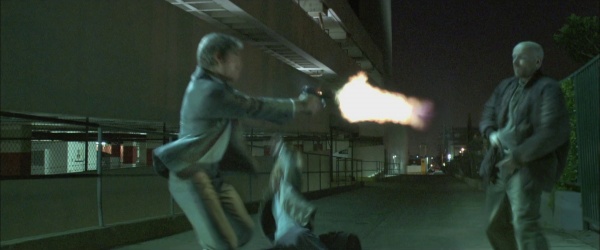
In this scene Vincent handcuffs Max on to the steering wheel and goes to kill another victim. While he is upstairs Max calls some people to give him hand to get rid of the handcuffs but they come out as mean people and stole Vincent’s bag. Vincent comes down and sees his bag missing; he goes after the men and kills them with quick reflexes. Suspense comes in when the other man tries to get out his gun, Vincent recognises and shoots him quickly as you can see on the above picture.

Here is a picture of the car crash scene, in this scene Max and Vincent are in the car coming from the party going to kill another victim, while Max is driving Vincent says something that effects Max. Max speeds up by going pass the red light because he has had enough of Vincent killing people, Vincent then holds a gun at Max's head and threatens to kill him but Max don’t care about anything and carries on speeding up. Max then speeds up onto a ramp turns the car badly so that the car can flip over, so he can get rid of Vincent. Suspense comes in as tension was built up all the way; because Vincent would not give a chance and kill Max but he did not instead the opposite happened and them both got away with it and managed to stay alive.

In the final scene of collateral I am going to talk about the train; this is the strongest scene as strange things happen. The scene takes place on the train as Max takes Annie as far as possible to prevent Vincent from not killing her as she is the last victim, but Vincent manages to get on the same train, when he actually goes to the train in front of him. When the train stops Vincent gets out of the train ready to shoot Max and Annie, but Max acts smart and stays on. The doors close and Vincent moves along to the next carriage where Max and Annie are to capture them. The shootout begins but nothing happens to now one as Vincent and Max run out of bullets which made the audience think they will fight but they sat down and started talking, Vincent looked like he had enough by facing is head down, Max and Annie both get off. In this scene the suspense came in when Vincent managed to get on the right train as he ran to the train in front instead of the one downstairs, but actually jumped at the train downstairs believing Max and Annie being there.
DEFINITION OF SUSPENSE
 In today's lesson we learnt what suspense means. Suspense is a feeling of uncertainty and anxiety about the outcome of certain actions, most often referring to an audience's perceptions in a dramatic work. Suspense is not exclusive to fiction, though. Suspense may operate in any situation where there is a lead up to a big event or dramatic moment, with tension being a primary emotion felt as part of the situation.
Wednesday, 27 January 2010
Definition of Suspense
Suspense. In the lesson the class were contributing in the question 'What is suspense?' and from the answers the class came up with built up on our understanding on what suspense is.
There are many ways in which suspense is known has, one of them is a cliff hanger, tension and many more.
But my definition of suspense is a word we use to describe a situation that happens in many context for example in a book we describe it has cliff hanger in which the author wants us the reader want to read on. In a film it is known has tension, because the director does it in such a way that we want to watch on and find what is going to happen next, the editor composes and joins the film in such a way that he puts different actions in one scene that makes us the viewers wander what is going to happen and how the current situation is going to be solved. This is clever has the audience is actually captivated by each piece and also make the viewers think of questions that relate to the film, which makes the film really entertaining for the viewers.
There are many ways in which suspense is known has, one of them is a cliff hanger, tension and many more.
But my definition of suspense is a word we use to describe a situation that happens in many context for example in a book we describe it has cliff hanger in which the author wants us the reader want to read on. In a film it is known has tension, because the director does it in such a way that we want to watch on and find what is going to happen next, the editor composes and joins the film in such a way that he puts different actions in one scene that makes us the viewers wander what is going to happen and how the current situation is going to be solved. This is clever has the audience is actually captivated by each piece and also make the viewers think of questions that relate to the film, which makes the film really entertaining for the viewers.
List of Thriller sub-genres - which inspires you at the moment and why?
I am going to talk about all kinds of thriller sub genres and explain, which sub genre is my favourite and why. There are 13 genres all together but they may be more but they are 13 main thriller sub genres in all. They are:
 The first sub genre, I am going to talk about is Action Thriller and that is a thriller that is a thriller that has so much suspense as it as so many things happening in the film,it tends to have so many violence in the film and it can include on the mise en scene props like Bombs, Guns and many other props to convey its sub genre. This may include films like: James Bond, The Transporter and many more.
 The next sub genre I am going to talk about is Crime Thrillers. This sub genre is really suspenseful as this type of film mainly tends to focus its attention more on the criminal than the police officers, films like this tend to have a lot of shootouts, chases, murders, robberies and many more. Films under this category are: seven, the killing, reservoir dogs and many other films.
Action Thriller
Conspiracy Thriller
Crime Thriller
Disaster Thriller
Drama Thriller
Erotic Thriller
Legal Thriller
Medical Thriller
Political Thriller
Psychological Thriller
Spy Thriller
Techno Thriller
Religious thriller
The first sub genre, I am going to talk about is Action Thriller and that is a thriller that is a thriller that has so much suspense as it as so many things happening in the film,it tends to have so many violence in the film and it can include on the mise en scene props like Bombs, Guns and many other props to convey its sub genre. This may include films like: James Bond, The Transporter and many more.The next sub genre I am going to talk about is conspiracy thriller. Is a genre in which case where conspiracy (paranoid) meets coincidence and the characters in the thriller do not know what to do as it leaves them questioning their status and how they can overcome it. It may include films like: The Dark Knight, X-Files and many other films
about is conspiracy thriller. Is a genre in which case where conspiracy (paranoid) meets coincidence and the characters in the thriller do not know what to do as it leaves them questioning their status and how they can overcome it. It may include films like: The Dark Knight, X-Files and many other filmsThe next sub genre I am going to talk about is Crime Thrillers. This sub genre is really suspenseful as this type of film mainly tends to focus its attention more on the criminal than the police officers, films like this tend to have a lot of shootouts, chases, murders, robberies and many more. Films under this category are: seven, the killing, reservoir dogs and many other films.The last of genre I am going to talk about is Disaster Thriller, which is thriller in which natural disaster tends to occur which leaves the actors scared, worrying and also makes them try to discover ways in beating the natural disasters and save the whole world. An example of this is:
am going to talk about is Disaster Thriller, which is thriller in which natural disaster tends to occur which leaves the actors scared, worrying and also makes them try to discover ways in beating the natural disasters and save the whole world. An example of this is:Volcano and many more.
My favourite Thriller sub genre is action based Thriller because, it always shows us what people would do in certain situations and also I belive it has the most suspense out of the all thriller sub genre. This is because the way they explore the suspense in the film i captivation and makes the viewer want to continue watching and also entertains the audience.
How is suspense created in the film you watched in class
I am going to talk about collateral and it creates suspense in the film.
 The first scene I am going to talk about is the car Crash scene, in this scene Max and Vincent are in the car driving and Vincent says something that Max does not like as they were both coming from a shoot out in a party So max speeds up going pass the red light because he has had enough of Vincent's killing, which leads Vincent to hold a gun at Max's head and threatened to kill him but max did not pay attention and continued to speed up. By this time, max had enough of Vincent's threat that he made a bad u-turn so that the car can flip over, so that Vincent could die. This is a significant scene because tension was built up all the way, because we thought that Vincent would kill Max but he did not instead the opposite happened and they were both still alive and did not seem to be affected by the crash that much.
 The next scene I am going to talk about is in Annie's Office, in this scene Annie is doing some research on the case she has to solve and does not that she is the next victim On Vincent's list, Vincent is already in the building and is looking for Annie, but does not see her because she is two floors above him as her computer does not work, whilst Vincent is checking Annie's office, Max is downstairs watching where Vincent is and warning Annie but at first Annie does not believe him as she thinks Max i playing games with her during this conversation Vincent looks at her office phone and notices that she is not on that floor but 2 floors higher and he proceeds to make his way to that floor, then Max spots that Vincent ha started to move and tries to warn Annie to try and get out but all of a sudden the connection is lost as the phone begins to lose power, so Max is forced to enter the building to try and save Annie, as the scene continues Vincent turns out the power in the whole office, which it made it kind of hard for annie to see, Max finds Annie because Vincent had caught her and was about to kill but Max saved her by shooting Vincent in the ear, in which Max and Annie made a narrow escape. This scene was intense because so much happened in a short space, for example we thought that Annie was going to die as Vincent had got her cornered but luckily she did not, then another scenario was when Max had a gun to Vincent, this was intense has both of them could have killed each other but in the end Max shot Vincent in the ear and made for the escape route.
 This is the final scene, I am going to talk about is the scene on the train, this is the most intense scene because it is the final showdown. The scene takes place on the train a Max and Annie try to escape but Vincent also jumps on the same train, which only means that either Vincent kills both Max and Annie or the other way around, as the train stops at the first stop Vincent gets ready to shoot at Max and Annie that he even jumps off the train to make sure he gets a clear aim, but Max and Annie both stay on the train because Max saw Vincent Jump off and knew that there will be no way off escaping, so he decides to move to the next carriage in which both Max and Annie try to stay low but do not succeed, so they start a shoot out in this scene but both run out of bullets, which made us think that they might fight it out but instead they sat down and started talking, but it looked like Vincent had died as his head was facing down, and Max and Annie both get off. This is important as it could have been Vincent or Max who could have won, so I believe that the way suspense was conveyed was really composed well.
Collateral is a film made in 2004 and the actors in the film are Jamie Foxx, Tom Cruise and Jada Pinkett Smith. This is an action thriller. I have selected three scenes, which I believe conveys tension to us really well and they are:
The Car crash scene
Annie's office scenery
The train scene
The first scene I am going to talk about is the car Crash scene, in this scene Max and Vincent are in the car driving and Vincent says something that Max does not like as they were both coming from a shoot out in a party So max speeds up going pass the red light because he has had enough of Vincent's killing, which leads Vincent to hold a gun at Max's head and threatened to kill him but max did not pay attention and continued to speed up. By this time, max had enough of Vincent's threat that he made a bad u-turn so that the car can flip over, so that Vincent could die. This is a significant scene because tension was built up all the way, because we thought that Vincent would kill Max but he did not instead the opposite happened and they were both still alive and did not seem to be affected by the crash that much.The next scene I am going to talk about is in Annie's Office, in this scene Annie is doing some research on the case she has to solve and does not that she is the next victim On Vincent's list, Vincent is already in the building and is looking for Annie, but does not see her because she is two floors above him as her computer does not work, whilst Vincent is checking Annie's office, Max is downstairs watching where Vincent is and warning Annie but at first Annie does not believe him as she thinks Max i playing games with her during this conversation Vincent looks at her office phone and notices that she is not on that floor but 2 floors higher and he proceeds to make his way to that floor, then Max spots that Vincent ha started to move and tries to warn Annie to try and get out but all of a sudden the connection is lost as the phone begins to lose power, so Max is forced to enter the building to try and save Annie, as the scene continues Vincent turns out the power in the whole office, which it made it kind of hard for annie to see, Max finds Annie because Vincent had caught her and was about to kill but Max saved her by shooting Vincent in the ear, in which Max and Annie made a narrow escape. This scene was intense because so much happened in a short space, for example we thought that Annie was going to die as Vincent had got her cornered but luckily she did not, then another scenario was when Max had a gun to Vincent, this was intense has both of them could have killed each other but in the end Max shot Vincent in the ear and made for the escape route.This is the final scene, I am going to talk about is the scene on the train, this is the most intense scene because it is the final showdown. The scene takes place on the train a Max and Annie try to escape but Vincent also jumps on the same train, which only means that either Vincent kills both Max and Annie or the other way around, as the train stops at the first stop Vincent gets ready to shoot at Max and Annie that he even jumps off the train to make sure he gets a clear aim, but Max and Annie both stay on the train because Max saw Vincent Jump off and knew that there will be no way off escaping, so he decides to move to the next carriage in which both Max and Annie try to stay low but do not succeed, so they start a shoot out in this scene but both run out of bullets, which made us think that they might fight it out but instead they sat down and started talking, but it looked like Vincent had died as his head was facing down, and Max and Annie both get off. This is important as it could have been Vincent or Max who could have won, so I believe that the way suspense was conveyed was really composed well.Monday, 25 January 2010
Thriller Sub-Genres
There are many thriller films, and they can be cut down to sub-genres such as:
Disaster Thriller Films: Disaster thriller films are based upon thriller, but most of the aspects are disasters. For example, the film The Day After Tomorrow is about storms and hurricanes.
Action Thriller Films: Action thriller films are based on a race against the clock and against good vs evil. Many violent scenes are included and in the end the good guy always prevails, but the bad guy drives the whole plot. Action thriller films such as Collateral which is mainly on action.
Religious Thriller Films: Religious thriller films are films that highly involve the aspects of religious matters in them, bit still contain the features of thriller, religious films such as, The Da Vinci Code.
Spy Thriller Films: Spy thriller films are usually of a hero who works for a good government agency and must go against a villain of the rival government agency. An example of a Spy thriller film is Mission: Impossible.
Legal Thriller Films: Legal thriller films contains a hero who is a lawyer in the courtroom and goes against an enemy, but in the end justice is served.
Drama Thriller Films: Drama thriller films are mainly just thriller/drama films, but they are a little more slowly paced. Drama thriller films such as The Runaway Jury.
Disaster Thriller Films: Disaster thriller films are based upon thriller, but most of the aspects are disasters. For example, the film The Day After Tomorrow is about storms and hurricanes.
Action Thriller Films: Action thriller films are based on a race against the clock and against good vs evil. Many violent scenes are included and in the end the good guy always prevails, but the bad guy drives the whole plot. Action thriller films such as Collateral which is mainly on action.
Religious Thriller Films: Religious thriller films are films that highly involve the aspects of religious matters in them, bit still contain the features of thriller, religious films such as, The Da Vinci Code.
Spy Thriller Films: Spy thriller films are usually of a hero who works for a good government agency and must go against a villain of the rival government agency. An example of a Spy thriller film is Mission: Impossible.
Legal Thriller Films: Legal thriller films contains a hero who is a lawyer in the courtroom and goes against an enemy, but in the end justice is served.
Drama Thriller Films: Drama thriller films are mainly just thriller/drama films, but they are a little more slowly paced. Drama thriller films such as The Runaway Jury.
Definition of Suspense

Suspense is another word for tension. The audience will not know what is going on until the big moment that makes them jump. It creates anticipation as they are unaware of what is about to happen. An example of a thriller film that creates suspense is Final Destination. In the supernatural thriller film, suspense is created throughout the entire film as the audience is kept in suspense. There is no killer present for the audience to see, the entire film is full of moments where the audience will jump which makes the film so suspenseful.
Thriller Sub Genres
A thriller movie is based on Justice Vs Injustice, the protagonist is at the mercy of the antagonist and often the antagonist drives the plot. There are many sub genres for thrillers and they are :
Political thrillers: In which the hero/ heroine must ensure the stability of the government that employs them. E.g 'Agency' ( 1980)
Action thriller: In which the work often features a race against the clock, contains lots of violence, and an obvious antagonist. These films usually contain large amounts of guns, explosions, and large elaborate set pieces for the action to take place. E.g 'Collateral' (2004)
Drama thriller: In which the story consists of the elements of a thriller and drama film. These films are usually slower paced and involves a great deal of character development along with plot twists. E.g ' The interpreter' (2005)
Disaster thriller:In which the main conflict is due to some sort of natural or artificial disaster, such as floods, earthquakes, hurricanes, volcanoes, etc., or nuclear disasters as an artificial disaster. E.g 'Stormy Weather' (1995)
Crime thriller: This particular genre is a hybrid type of both crime films and thrillers that offers a suspenseful account of a successful or failed crime or crimes. These films often focus on the criminals rather than a policeman. Crime thrillers usually emphasize action over psychological aspects. Central topics of these films include murders, robberies, chases, shootouts, and double-crosses are central ingredients. E.g 'Inside Man' (2006)
Psychological thriller:In which (until the often violent resolution) the conflict between the main characters is mental and emotional, rather than physical. E.g ' The Good Son' (1993)
At the moment the psychological thrillers are inspiring me because suspense is created through the characters physical and mental state which are very unpredictable so you don't know what could happen unlike the other thrillers they lack originality because usually they are quite predictable and they have the same story lines.
An example of a psychological thriller is The Butterfly Effect. I think this movie influences me
alot due to use of suspense and hopefully in my group we could do something similar.
Political thrillers: In which the hero/ heroine must ensure the stability of the government that employs them. E.g 'Agency' ( 1980)
Action thriller: In which the work often features a race against the clock, contains lots of violence, and an obvious antagonist. These films usually contain large amounts of guns, explosions, and large elaborate set pieces for the action to take place. E.g 'Collateral' (2004)
Drama thriller: In which the story consists of the elements of a thriller and drama film. These films are usually slower paced and involves a great deal of character development along with plot twists. E.g ' The interpreter' (2005)
Disaster thriller:In which the main conflict is due to some sort of natural or artificial disaster, such as floods, earthquakes, hurricanes, volcanoes, etc., or nuclear disasters as an artificial disaster. E.g 'Stormy Weather' (1995)
Crime thriller: This particular genre is a hybrid type of both crime films and thrillers that offers a suspenseful account of a successful or failed crime or crimes. These films often focus on the criminals rather than a policeman. Crime thrillers usually emphasize action over psychological aspects. Central topics of these films include murders, robberies, chases, shootouts, and double-crosses are central ingredients. E.g 'Inside Man' (2006)
Psychological thriller:In which (until the often violent resolution) the conflict between the main characters is mental and emotional, rather than physical. E.g ' The Good Son' (1993)
At the moment the psychological thrillers are inspiring me because suspense is created through the characters physical and mental state which are very unpredictable so you don't know what could happen unlike the other thrillers they lack originality because usually they are quite predictable and they have the same story lines.
An example of a psychological thriller is The Butterfly Effect. I think this movie influences me
alot due to use of suspense and hopefully in my group we could do something similar.
How is suspense created in the film you watched in class ?
 In class we watched the movie 'Collateral' starring actors Jamie Foxx and Tom Cruise. The main plot line is that a cab driver Max ( Jamie Foxx) finds himself hostage of an engaging contract killer Vincent ( Tom Cruise) as he makes rounds from hit to hit during one night in L.A. He must find a way to save himself and one last victim Annie ( Jada Pinkett).
This is the scene where Vincent is in the building trying to look for his last victim. Suspense is created due to the lights going out in the building , this makes the audience anxious because if he finds his victim we know what he is capable off. The music also heightens the tension in this scene.
 In this scene Max and Annie are running away from Vincent. Unlike the other scene the lighting in this scene is bright so we can see clearly what is going on. Suspense is created by Max and Annie running away and not knowing what way to go in the train station. Anticipation is made making the audience want to know whether they manage to escape unharmed or if the worst happens.
 This is scene where Vincent manages to track Max and Annie. Suspense is created through the characters feelings, we know that Max and Annie are feeling terrified and as the picture shows Vincent is so close to them so it raises tension in the audience because we know what is going on.
Suspense
In our media lesson we were talking about the different meanings of 'Suspense' and we came up with a few definitions which are :
- Building something up to appear tense.
- Paranormal activity is an example of a movie that has a suspense element.
- Makes the audience feel excited or anxious, creates uncertaintainty of what may happen.
- 'Cliffhanger'- tense moment at the end.
- The lighting can create suspense.
- Ticking time bomb can heighten suspense.
- Characters can create suspense
- Building something up to appear tense.
- Paranormal activity is an example of a movie that has a suspense element.
- Makes the audience feel excited or anxious, creates uncertaintainty of what may happen.
- 'Cliffhanger'- tense moment at the end.
- The lighting can create suspense.
- Ticking time bomb can heighten suspense.
- Characters can create suspense

BAIT - TUTORIAL
 In todays lesson we developed our media skills by doing editing. We learnt different kinds of ways to edit a video clip.
- Final cut pro - BAIT tutorial
- Cutting clips with the razor tool
- Dragging clips from BROWSER to viewer
- IN + OUT point making
- Dragging clips to the timeline
- How to edit a match cut
Technical audit of Bait tutorial

In the lesson we were learning how to edit using an application called final cut pro and it was a good experience as it refreshed my mind on how to re-use Final cut pro. We had to try and create our own mini form of a movie that made sense using the tutorial clips cuts. The teacher was going through step by step how we use the program and made us try after her then she continued.
Audit Of Bait Tutorial

In today's Media lesson, we were asked to edit some clips from Bait. We learned many different ways of how to edit, for example, how to input and output clips and put it together to make one scene. In my clip I put together a scene with many different clips and managed to involve many match cut in between to link the clips together. We also learned how to move the browser to the viewer, how to use a razor tool and how to drag some clips down to the timeline.
Technical audit of bait tutorial

In my media lesson today we had a tutorial of a program called Final cut. This program is used to edit scenes and i had the task of editing a scene using this program. I learnt how to cut clips using the razor tool, dragging clips from the browser to the timeline and creating an input and output point. The purpose of this was to learn how to create matchcuts and create a scene constructed by the clips i had chosen. This tutorial is helpful because i have now learnt the basics of editing clips and i will be able to use what i have learnt when i have to edit my film.


PHOTO ACTIVITY
In todays lesson we have been set to do a photo activity. We had to go around taking pictures that reflect words that has been given.

This is a picture of a member of our group and this picture reflects to the word City as you can see the city on the background.

This is a picture of a member of the group and this picture reflects to the word quick as he was spinning fast. You can also see the notion when you look at the picture closely.

This is a picture of a member of the group and this picture reflects to the word Claustrophobic. This picture shows that she is claustrophobic of small places as you can see the way she is composed in this scene, which shows that she feels that the walls are closing in on her and she is feeling isolate.

This picture also reflects to the word claustrophobic a little girl sitting on a small hole on the staircase very calm, which shows us that she is alone and left out.

This is a picture of a member of our group and this picture reflects to the word City as you can see the city on the background.
This is a picture of a member of the group and this picture reflects to the word quick as he was spinning fast. You can also see the notion when you look at the picture closely.
This is a picture of a member of the group and this picture reflects to the word Claustrophobic. This picture shows that she is claustrophobic of small places as you can see the way she is composed in this scene, which shows that she feels that the walls are closing in on her and she is feeling isolate.
This picture also reflects to the word claustrophobic a little girl sitting on a small hole on the staircase very calm, which shows us that she is alone and left out.
Photo Task
Our task for our lesson today was to take six pictures of six words from a list. I have chosen and pictures to write about and they represent the following words:Depression, Claustrophobic, City and Quick.

This shot evokes ' Depression'. It evokes the word because the picture has been from a high angle making her look vulnerable. Her body language shows that she is depressed, the scenery also reflects on this because she is sitting inside a small hole in the wall.

This shot evokes ' claustrophobic'. This is shown through the mise en scene. She is in a small space and her body language indicates that she feels trapped. The picture was taken from a high angle because it reinforces that she feels trapped in the small space making her feel claustrophobic.

This picture evokes 'City'. It evokes city because we have taken a picture of our group members with the background of the city. This is effective because you can get a view of the city from the window and this could give us ideas for our thriller movie, we could use pictures of different landscapes.

This picture evokes 'Quick'. You are able to see this through his movement, there seems like there is an effect when he is moving quickly.

This shot evokes ' Depression'. It evokes the word because the picture has been from a high angle making her look vulnerable. Her body language shows that she is depressed, the scenery also reflects on this because she is sitting inside a small hole in the wall.

This shot evokes ' claustrophobic'. This is shown through the mise en scene. She is in a small space and her body language indicates that she feels trapped. The picture was taken from a high angle because it reinforces that she feels trapped in the small space making her feel claustrophobic.

This picture evokes 'City'. It evokes city because we have taken a picture of our group members with the background of the city. This is effective because you can get a view of the city from the window and this could give us ideas for our thriller movie, we could use pictures of different landscapes.

This picture evokes 'Quick'. You are able to see this through his movement, there seems like there is an effect when he is moving quickly.
Subscribe to:
Posts (Atom)